
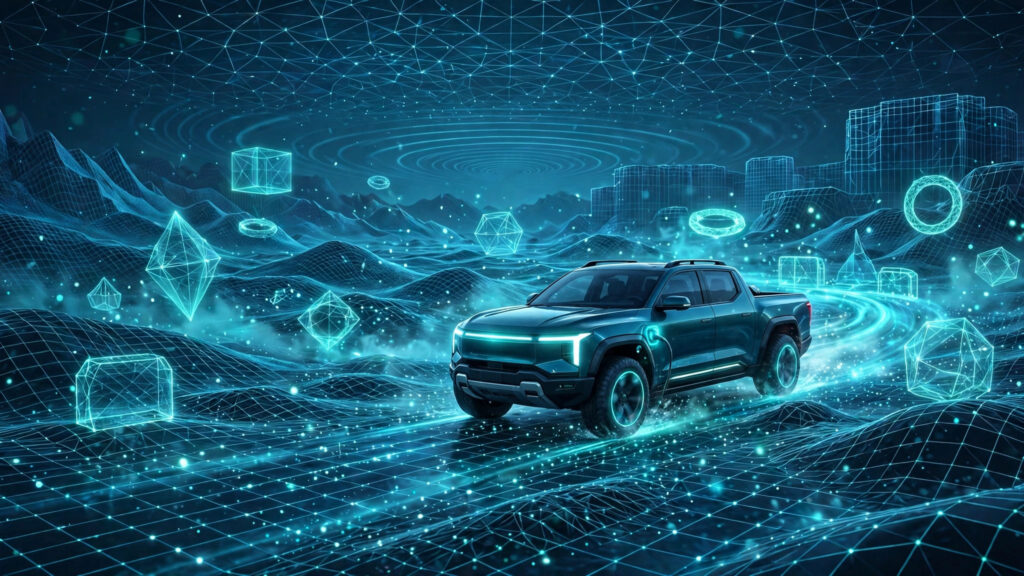
Self-driving cars have a practice problem: the most important moments on the road are the rare, dangerous ones you cannot safely rehearse in real life. Rivian’s latest move is aimed squarely at that problem. The electric vehicle maker has acquired Third Dimension AI, a startup working on world models — AI systems that learn how the physical world behaves so software can practise inside a simulation. The deal, reported on October 22, underlines how seriously automakers now treat simulated miles as the shortcut to safer autonomy.

What Are World Models?
A world model is an AI system that builds an internal representation of an environment — how objects move, how light and weather change a scene, what happens next when a car brakes or a pedestrian steps off a kerb. Trained well, it can generate or predict realistic scenarios on demand. For self-driving developers, that is gold: instead of waiting months for a rare event to occur naturally in test fleets, engineers can summon it a thousand times before lunch, in endless variations, without risking a single real bumper.
The same simulation-first thinking is spreading across physical industries — this week, Mistral and Nvidia teamed up to bring AI agents into industrial engineering, where digital replicas of factories and machines serve the same purpose: practise in software before committing in the real world.
Why Rivian Wants This In-House
Rivian is best known for its R1T pickup, R1S SUV and the delivery vans it builds for Amazon, and like every serious EV maker it is investing heavily in driver assistance and autonomy. Buying a world-model startup, rather than licensing the technology, suggests Rivian wants the capability woven deep into its own development loop — generating training data tuned to its vehicles, its sensors and the edge cases its fleet actually encounters.
There is also a data-privacy dimension to fleets that record the world all day. Real street imagery used for training must be handled carefully, which is why anonymisation techniques matter in this industry — the consumer equivalent is the one-tap AI face blur tool that hides faces in photos before they are shared. Different scale, same principle: powerful visual AI works best when privacy is engineered in, not bolted on.
The Race to Simulate Everything
Rivian is not alone. Across the industry, the bottleneck in autonomy has shifted from collecting miles to generating the right miles. World models promise to compress years of edge-case hunting into weeks of compute — provided the simulations are faithful enough that skills transfer to real roads. That “sim-to-real” gap is the field’s central scientific challenge, and it is why startups with genuine world-model expertise have become prized acquisition targets for carmakers, robotics firms and chip giants alike.
For the rest of us, the technology trickles down in friendlier forms. The same generative understanding of images powers playful tools like a photo to sketch converter, and the full range of free AI tools shows how quickly research-grade ideas become everyday utilities.
What to Watch Next
The test of this deal will be visible in Rivian’s driver-assistance features over the coming product cycles: faster improvement, better handling of construction zones, night rain and other hard cases would all be fingerprints of a strong simulation programme. Acquisitions in AI are easy to announce and hard to integrate, but the strategic logic here is clear — in the autonomy race, the best simulator may matter as much as the best car.
Frequently Asked Questions
What did Rivian acquire?
Rivian acquired Third Dimension AI, a startup specialising in world models — AI systems that simulate the physical world so self-driving software can train and be tested virtually.
Why do self-driving cars need world models?
They let engineers generate rare and dangerous scenarios safely and repeatedly in simulation, instead of waiting for them to happen during real-world testing.
Is this only about cars?
No. World models and simulation are also used in robotics, industrial engineering and any field where practising in software is cheaper and safer than practising in reality.