
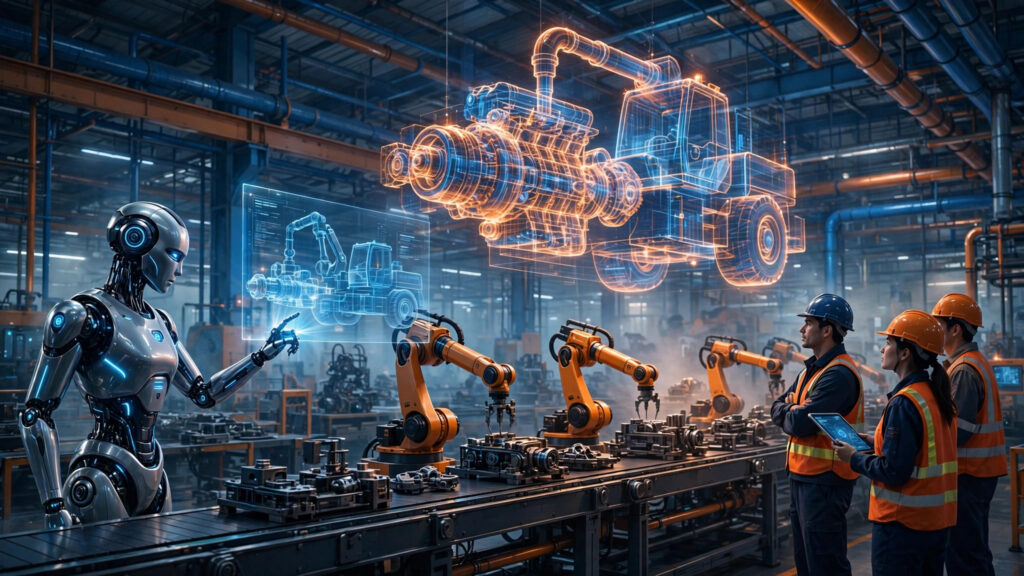
Factories, power plants and aircraft programmes run on engineering software that has barely changed in decades — powerful, precise and famously unforgiving to use. Mistral and Nvidia are betting AI agents can change that. The two companies announced on October 21 that they are bringing agent technology into industrial engineering, pairing Mistral’s AI models with Nvidia’s computing and simulation platforms to help engineers design, test and optimise complex systems faster.
What the Partnership Targets
Industrial engineering is a world of CAD models, physics simulations and digital twins — virtual replicas of machines and production lines that engineers interrogate before anything physical is built. The work is high-value but slow: setting up a simulation, checking constraints and iterating on a design can consume days of specialist time. AI agents promise to compress that loop. An agent that understands engineering context could prepare simulation setups, explore design variations, flag where a part fails tolerance, and summarise results — leaving human engineers to make the judgment calls that carry legal and safety weight.
The pairing is complementary. Mistral, the French AI company known for efficient, open-leaning models, supplies the reasoning layer. Nvidia supplies the heavy machinery: GPUs and a mature simulation ecosystem that industry already uses for digital twins. Together they can offer manufacturers an agent stack that runs where the engineering data already lives.
Why Industry Is Ripe for Agents
Three pressures make industrial firms receptive. Skilled engineers are scarce and retiring faster than they are replaced. Product cycles keep shrinking while systems grow more complex. And the cost of a late-discovered design flaw — a factory line rebuilt, a component recalled — dwarfs the cost of extra simulation. Agents that explore more of the design space earlier attack all three problems at once.
Simulation is becoming the common thread of applied AI. The same week, Rivian acquired a world-model startup so its vehicles can practise driving in virtual worlds. Whether the “factory” is a car plant or a simulated highway, the strategy is identical: let AI rehearse in software, where mistakes are cheap, before acting in the physical world, where they are not.
The Enterprise Pattern Behind It
This deal also confirms how enterprise AI is being sold in 2026: not as raw models, but as partnerships aimed at a specific industry’s workflow — the same logic behind xAI’s partner network for Grok. For Mistral, industrial engineering offers something else valuable: a European stronghold. Manufacturers wary of depending entirely on US platforms may welcome a French model provider working with Nvidia’s global hardware base.
On the ground, engineering work is also full of small, document-heavy tasks where lighter AI already helps — dictating inspection notes with voice typing on the factory floor, or turning reference photos into diagrams with a photo to sketch converter during early design discussions. The agent era builds on these habits rather than replacing them, and our free AI tools library shows how quickly such utilities spread once people see the point.
What to Watch Next
The proof will be in named deployments: a manufacturer cutting design cycles, a simulation workflow measurably shortened. Industrial buyers are conservative for good reason — safety cases and certifications move slowly — so expect pilots first, headlines later. But the direction is unmistakable: agents are leaving the chat window and entering the engineering department.
Frequently Asked Questions
What did Mistral and Nvidia announce?
On October 21, the two companies announced a collaboration to bring AI agents into industrial engineering, combining Mistral’s models with Nvidia’s compute and simulation platforms.
What would AI agents do for engineers?
They can prepare simulations, explore design variations, check constraints and summarise results, speeding up work with CAD models and digital twins while humans keep final judgment.
Why does this matter beyond manufacturing?
It shows enterprise AI moving into specialised, high-stakes workflows — a pattern repeating across sectors from automotive to finance.