
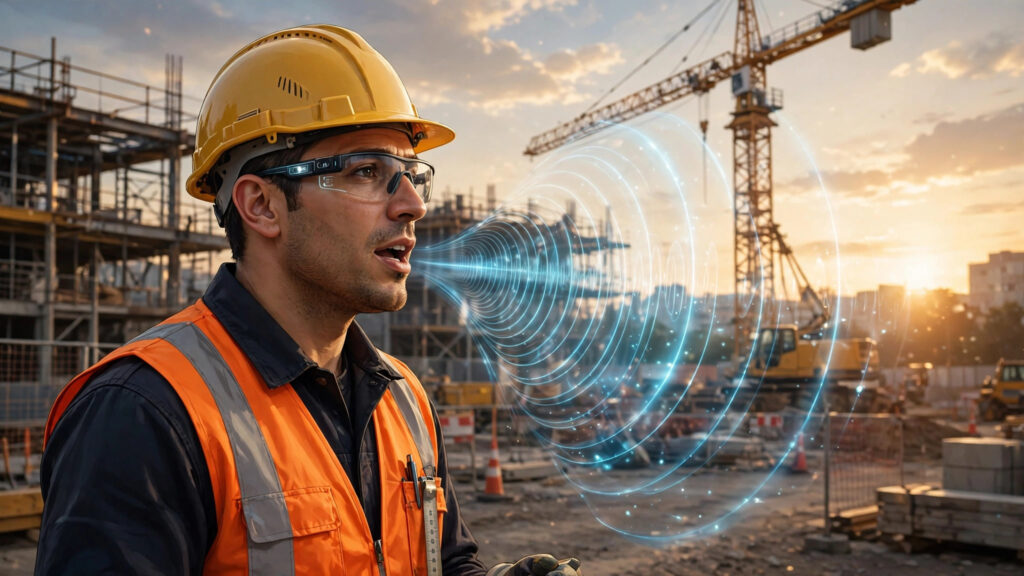
Construction sites are about the worst office imaginable for a keyboard: gloves, dust, noise, ladders, and hands that are usually holding something. Procore, whose software manages construction projects around the world, has leaned into that reality with Procore AI Go — a voice-first jobsite app announced on October 21, launched alongside Meta AI glasses. The idea is simple: on a jobsite, the best interface is the one you can use without putting your tools down.

Why Voice Fits the Jobsite
Field work generates a constant stream of small, important records: deliveries checked, defects spotted, safety issues noticed, work confirmed complete. When recording those things means walking to a trailer, removing gloves and typing, many of them simply never get recorded — and missing field data becomes disputes, delays and rework later. A voice-first app attacks that friction directly. Speak the observation, let the AI structure it, and move on.
It is the same reason voice interfaces keep winning in hands-busy environments generally. Away from the site, the principle powers everyday tools like our voice typing tool, which turns speech into text in the browser. On site, with an AI layer on top, spoken notes can be tagged, filed and shared as part of the project record automatically.
Where the Meta AI Glasses Come In
The launch pairs the app with Meta AI glasses, and the combination is the real story. Glasses put a camera and microphone at eye level, hands-free — the worker sees a problem, describes it, and the record is captured from their point of view. For inspections, walkthroughs and remote assistance, a supervisor can effectively see what the worker sees without being there.
Procore is not alone in betting on eyewear. Alibaba’s Qwen N1 glasses are leading a wave of AI hardware in China, and Meta’s glasses are becoming the reference platform in the West. Construction is an unusually good testbed: the value of hands-free capture is obvious, and the alternative — clipboards and end-of-day paperwork — is obviously worse.
What It Changes for Project Teams
Better field data has knock-on effects. Daily logs write themselves from spoken notes. Safety observations get captured in the moment instead of reconstructed on Friday. Punch lists and inspection records come with photos taken from the worker’s viewpoint. None of this removes the need for professional judgement — the AI structures what the human observes — but it removes the clerical tax that has always made jobsite documentation incomplete.
The pattern matches what is happening in other field industries: rugged, AI-capable hardware like Getac’s B360X notebook with edge AI is arriving to run intelligence on-site rather than in a distant data centre. Voice, wearables and edge computing are converging on the same goal — technology that works where the work is. More voice and productivity utilities live in our free tools library.
The Bottom Line
Procore AI Go is a useful reminder that the AI race is not only about models; it is about interfaces. For a workforce that cannot stop to type, voice plus glasses may do more than a smarter chatbot ever could. If the launch succeeds, expect every field-work software category — maintenance, logistics, inspections — to copy the playbook.
Frequently Asked Questions
What is Procore AI Go?
Announced on October 21, Procore AI Go is a voice-first app for construction jobsites from Procore, the construction management software company. It launched alongside Meta AI glasses.
Why voice-first for construction?
Jobsite work is hands-busy, gloved and noisy. Speaking observations is faster and more likely to happen than stopping to type, so records get captured in the moment.
What do the Meta AI glasses add?
They provide a hands-free camera and microphone at eye level, letting workers capture what they see while the app records and structures their spoken notes.