
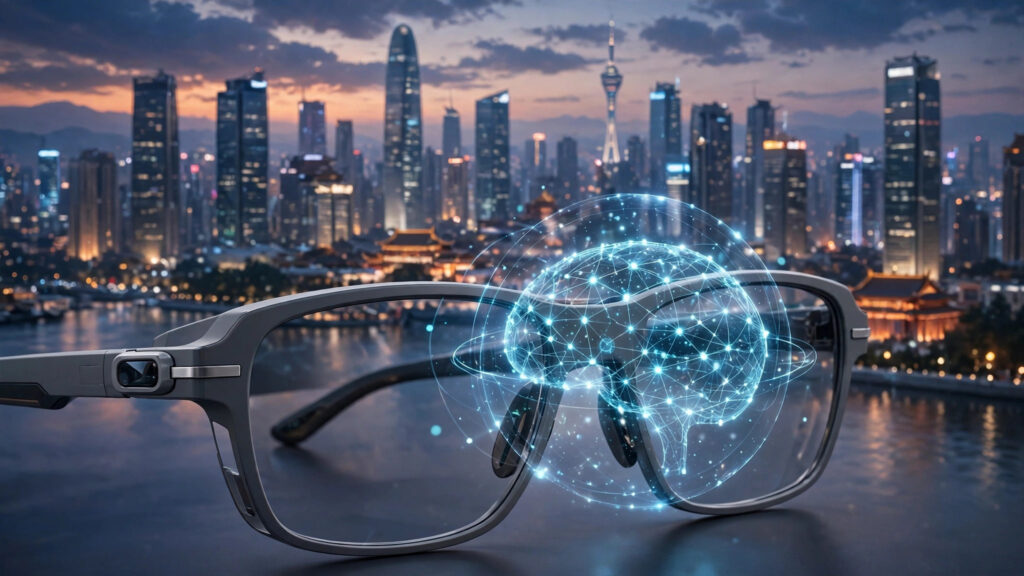
The smartphone taught the industry that the winning AI interface might not be a phone at all — it might be glasses. Alibaba made that bet explicit on October 23 with the Qwen N1 glasses, smart eyewear built around its Qwen family of AI models. The launch puts Alibaba at the front of a fast-forming wave of Chinese AI hardware, as the country’s tech giants race to put their models onto faces, wrists and everything else people carry.

Qwen Leaves the Chat Window
Qwen is Alibaba’s flagship AI model family, best known as a chatbot and as open models that developers build on. Glasses change the relationship. Instead of opening an app and typing, the wearer gets an assistant that sees the world from their point of view and answers in context — identifying objects, translating scenes, summarising what is in front of them. It is the difference between asking about the world and an AI that is standing in it with you.
That shift — from AI you visit to AI that accompanies you — is the theme of this year’s hardware season. Meta has been pushing the same idea in the West, most recently alongside field-work launches like Procore’s voice-first jobsite tools and Meta AI glasses. Alibaba’s entry confirms the glasses race is now fully global, with ecosystems rather than gadgets as the real prize.
China’s AI Hardware Wave
The Qwen N1 does not arrive alone; it headlines a broader movement. Chinese manufacturers have deep supply chains, fast product cycles and huge domestic markets, and they are applying all three to AI devices — glasses, recorders, pins, rings and new phone formats. The strategy is familiar from the smartphone era: ship quickly, iterate in public, and let volume drive prices down faster than rivals expect.
For consumers, competition of this kind is usually good news. Features that debut in premium Western devices tend to arrive cheaper and sooner when Chinese brands pile in. The same week saw Apple stake out the opposite end of the market with its $1,999 foldable iPhone Duo — ultra-premium on one side, fast-and-broad on the other, and the shape of the AI device market being negotiated between them.
What AI Glasses Still Have to Prove
Glasses are a demanding product. They must be light enough to wear all day, discreet enough not to feel like a costume, and restrained enough not to alarm everyone around the wearer — cameras on faces raise real social and privacy questions, the same ones that make people reach for tools like our AI face blur before posting photos of crowds. Battery life, heat and genuinely useful software matter more than launch-day demos.
The software side is where models like Qwen earn their keep: translation while travelling, visual answers while shopping, hands-free capture while working. Creative uses follow quickly too — a photo seen is a photo taken, and wearers will edit and share through familiar utilities, from sketch effects in our photo to sketch converter to the wider set in our free tools library.
The Bottom Line
The Qwen N1 glasses matter less as a single product than as a signal: China’s biggest AI players are done keeping their models inside apps. Glasses are where the industry believes ambient AI will live, and Alibaba just claimed a leading spot in that future. Whether wearers agree will be decided the way it always is — on faces, not on stages.
Frequently Asked Questions
What are the Qwen N1 glasses?
They are smart glasses from Alibaba, announced October 23, built around the company’s Qwen AI models, putting an AI assistant in the wearer’s field of view.
Why are so many companies making AI glasses?
Glasses offer a hands-free camera, microphone and display at eye level, which makes them a natural home for an AI assistant that can see and hear what the wearer does.
How does this fit China’s wider AI push?
The N1 leads a wave of Chinese AI hardware — devices that carry domestic AI models into everyday products, using China’s manufacturing speed and scale to compete globally.