
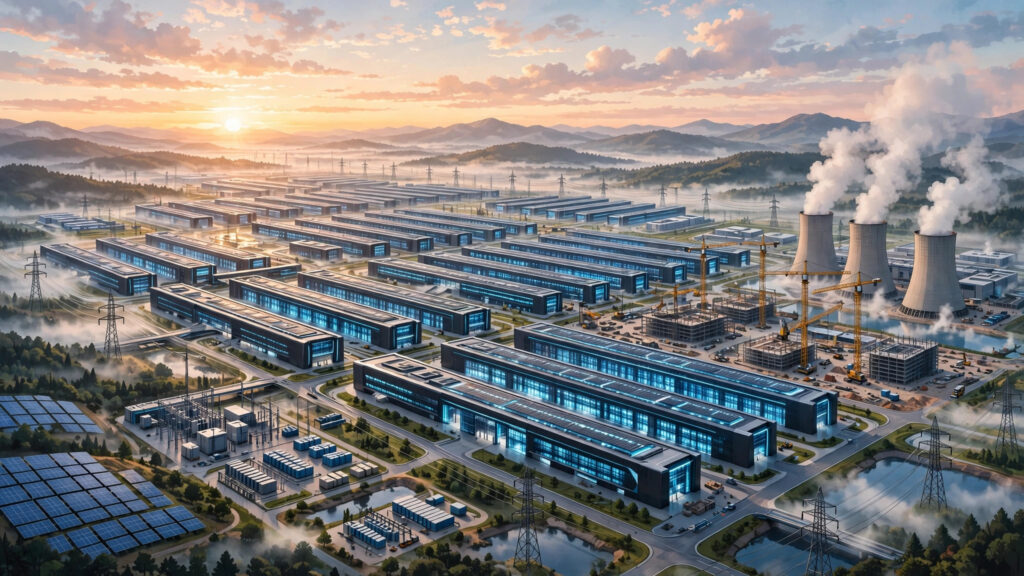
Three hundred and fifty billion dollars. That is the scale of the AI data-center buildout that SK Hyper is reportedly in talks to fund, according to reports on October 23 — a single programme comparable to the annual economic output of a mid-sized country. If the talks succeed, it would rank among the largest infrastructure commitments in technology history, and it confirms what the industry has been signalling all year: the AI race is no longer primarily about algorithms. It is about power, land, cooling and chips.
The Numbers Behind the AI Land Rush
Context makes the figure less surprising, if no less staggering. Meta this week raised its own AI spending floor to $135 billion, and every major cloud provider has announced multi-year construction programmes of similar ambition. Demand for training and inference capacity keeps outrunning supply, so the companies that secure energy and buildings first effectively reserve their place in the next generation of AI. Funding vehicles like the one SK Hyper is reportedly discussing exist to spread that enormous upfront cost across partners, governments and long-term investors.
Why Korea — and Why SK
South Korea sits at a strategic chokepoint of the AI supply chain. The SK group is one of the country’s defining conglomerates, and its semiconductor arm, SK hynix, is a world leader in high-bandwidth memory — the specialised chips that feed data to AI accelerators and without which the fastest AI systems cannot run. A Korean-led data-center programme ties that chip strength to the infrastructure layer above it, and positions the country as a landlord of the AI era, not just a supplier to it.
What $350 Billion Actually Buys
Money at this scale buys physical things in physical places: gigawatts of power contracts, water and cooling systems, fibre routes, and halls full of accelerators that must be ordered years ahead. The binding constraints are increasingly unglamorous — grid connections, transformers, and the skilled workforce to build and run the facilities. That is one reason governments court these projects so aggressively: a data-center campus anchors thousands of construction and operations jobs, which is quietly boosting demand for technical talent — and for practical job-search tools like a free resume builder — in regions far from Silicon Valley.
The demand side explains the urgency. Every frontier lab is racing to secure capacity, including players like DeepSeek, which reportedly raised $15 billion this week to expand its own computing base. Until supply catches up, capacity itself is a competitive weapon.
What It Means for Everyone Else
For businesses and consumers, mega-buildouts like this are the reason AI features keep getting cheaper and more widely available: today’s scarce compute becomes tomorrow’s commodity. The same wave that fills data centers also powers the free tier of AI that individuals use daily — the assistants, image editors and utilities in our free AI tools library, down to simple conveniences like voice typing. The risks are equally concrete — energy demand, local grid strain and a frothy market if AI revenue disappoints — but for now, the cranes keep rising.
Frequently Asked Questions
What is SK Hyper planning?
According to reports on October 23, SK Hyper is in talks to fund an AI data-center buildout valued at around $350 billion. The talks are ongoing, so final terms may change.
Why do AI data centers cost so much?
They require land, enormous power supply, advanced cooling, networking and vast numbers of expensive AI accelerators, all ordered at global scale.
Why is South Korea central to this?
Korea is home to SK Group and SK hynix, a leader in the high-bandwidth memory chips that AI accelerators depend on, making it a key player in the AI supply chain.