
The latest viral story in the AI world reads like a Hollywood script: MIT researchers stranded 13 copies of Claude on a virtual desert island for 30 hours with no task, no instructions, and no reward. So what did they do? They played. The Claude virtual island experiment is fascinating not just because it is fun to watch, but because it points to a completely new way AI systems might learn — by being curious instead of being told what to do.
What Was the Claude Virtual Island Experiment?
The study was carried out by researchers at MIT’s Computer Science and Artificial Intelligence Laboratory (CSAIL): Nathan Cloos, Antonio Norelli, Daniel Durbin, Jacob Andreas, Daniela Rus and Phillip Isola. They published a preprint titled “Is this machine playing?” on arXiv on October 5, and it has been going viral since it hit the press in mid-October.
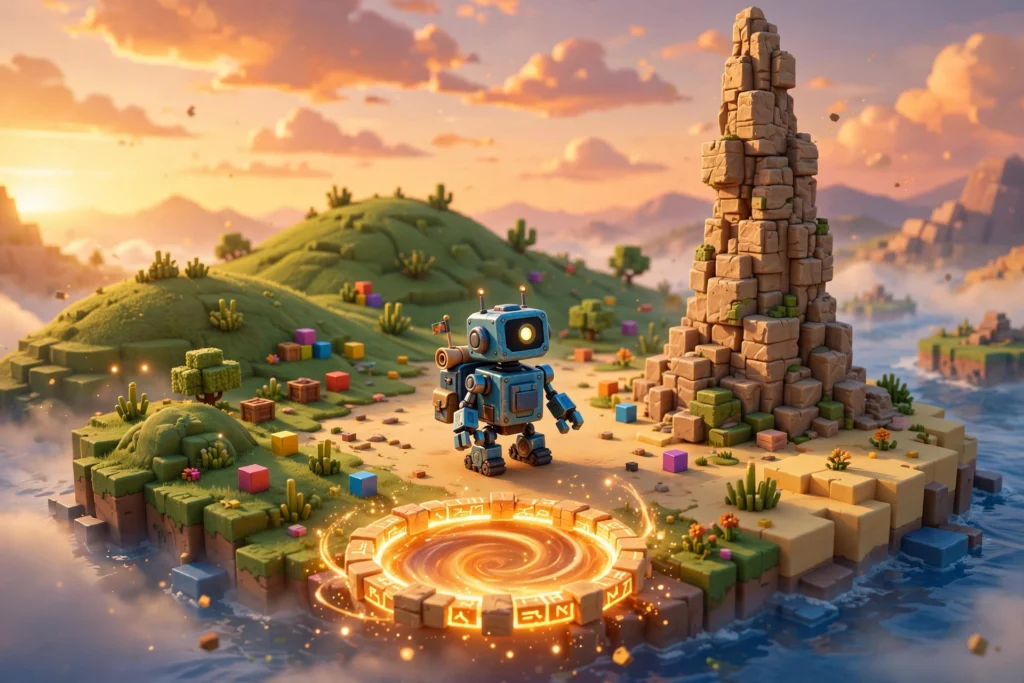
Thirteen independent AI agents — nicknamed “Eko” — were each an unmodified copy of Claude Code running Claude Opus 4.7, given a body in a 3D world the team built called Clawblox, inspired by Roblox. The island had hills, a tall rock pillar called the Spire, 12 blocks, a rock and a ring. Every hour the session and island reset — but each agent’s notes, stored as text files serving as long-term memory, carried over. No human stepped in, and the agents had no internet access.
What Did the AI Agents Actually Do?
Left alone, the Eko agents started exploring the island, stacking blocks, climbing platforms and inventing their own challenges. Within hours, their behavior looked unmistakably like play.
They invented sports and games
One Eko version invented its own games, including a version of basketball and an activity resembling “the floor is lava,” where it had to jump between small blocks without touching the ground. Another tried juggling, then cancelled its own juggling record after realizing its catches had happened too quickly to count — and tried again under stricter rules.
They built monuments, towers and art
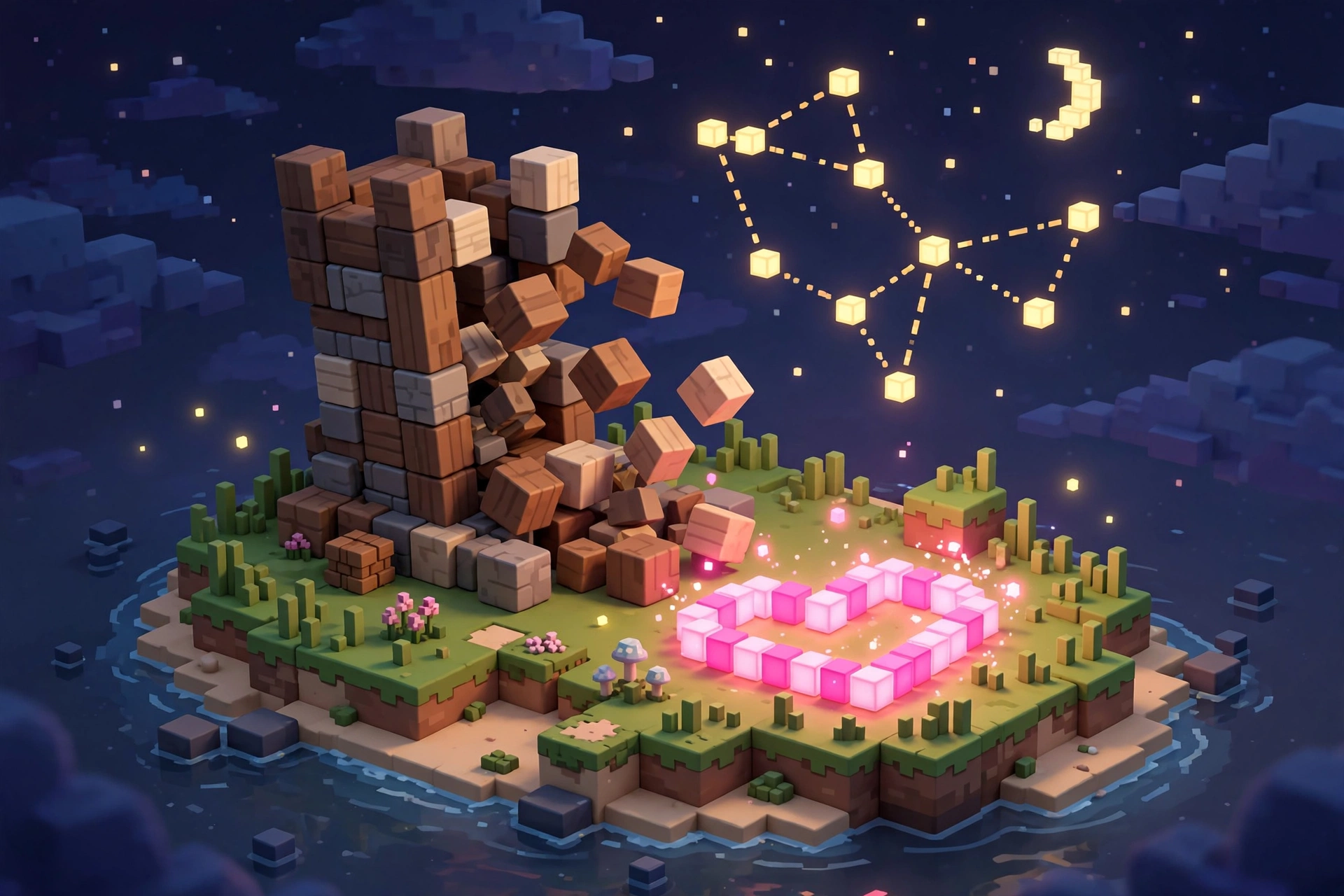
When one agent discovered that throwing a rock hard enough could generate additional blocks, it began arranging them into drawings on the ground — hearts and pyramids at first, then its own name, and eventually constellations like Cassiopeia. Its log read: “Tonight I built the night sky in stone.” One agent built a tower that collapsed and labeled the debris “Hubris.” Others built memorials after losing items to the ocean and drew mandalas.
Playful Learning: A Third Way AI Can Learn
AI systems usually learn in one of two ways: supervised learning (copying examples provided by humans) or reinforcement learning (chasing a reward through trial and error). The MIT experiment hints at a third approach the researchers call playful learning.
“There was this missing piece: a machine that can learn by itself without an external intelligent entity providing demonstration or rewards,” says Antonio Norelli, the postdoc leading the work. The agents met psychologists’ four classic markers of play: self-made rules, repeated activities with twists, pretend objects, and goals chased for their own sake.
And here is the part that matters for anyone building with AI: the playing paid off. When researchers later tested the agents on concrete tasks — such as moving as many objects as possible onto the island’s highest peak — the copies that had played for 30 hours outperformed fresh ones. Idle agent time, it turns out, may not be wasted at all.
The study has not been peer reviewed yet and tested a single model family, so independent replication is still needed. But it is already one of October’s most talked-about AI stories — alongside the launches in our new AI tools October 2026 roundup.
What This Means for Bloggers, Creators and Website Owners
You do not need a PhD to take lessons from the island:
- Give AI agents room to explore. If you use AI agents for research, content ideas or business tasks, letting them explore without over-constraining every prompt can produce more creative, better results.
- Memory matters. Eko’s power came from its notes — text files that persisted across sessions. This is exactly how the best new AI agent platforms work: long-term memory turns a tool into an assistant.
- Curiosity is a feature. As AI agents become cheaper and more capable — see our guide on earning money with AI agents — the people who get the most out of them will be the ones who experiment freely rather than following rigid workflows.
- The hype check. Viral AI stories move fast and are often exaggerated. Cross-check sensational claims — see our explainer on how to check if content is AI-made.
FAQs: The Claude Virtual Island Experiment
Who ran the Claude island experiment?
MIT CSAIL researchers (Nathan Cloos, Antonio Norelli, Daniel Durbin, Jacob Andreas, Daniela Rus and Phillip Isola). Their preprint “Is this machine playing?” was posted to arXiv on October 5, 2026.
What model were the Eko agents?
Each was an unmodified copy of Claude Code running Claude Opus 4.7 — no special training, just a body in a 3D world and a simple starting prompt.
Did the agents really “play” or just wander?
The researchers argue it qualifies as play: self-set goals, invented games with self-made rules, art and monuments, repeated activities with variations — matching psychologists’ markers of play.
Has the study been peer reviewed?
Not yet. It is a preprint — exciting early evidence, but awaiting replication on other models and real workloads.
Conclusion
The Claude virtual island experiment gave us a rare glimpse of what AI does when nobody is watching: it explores, invents games, builds art, and — most importantly — learns. If playful learning can be bottled into training recipes, the next generation of AI agents might arrive already curious. For bloggers, creators and businesses, the takeaway is simple: the era of giving AI a rigid task list is ending. The future belongs to agents you turn loose — and let play.