
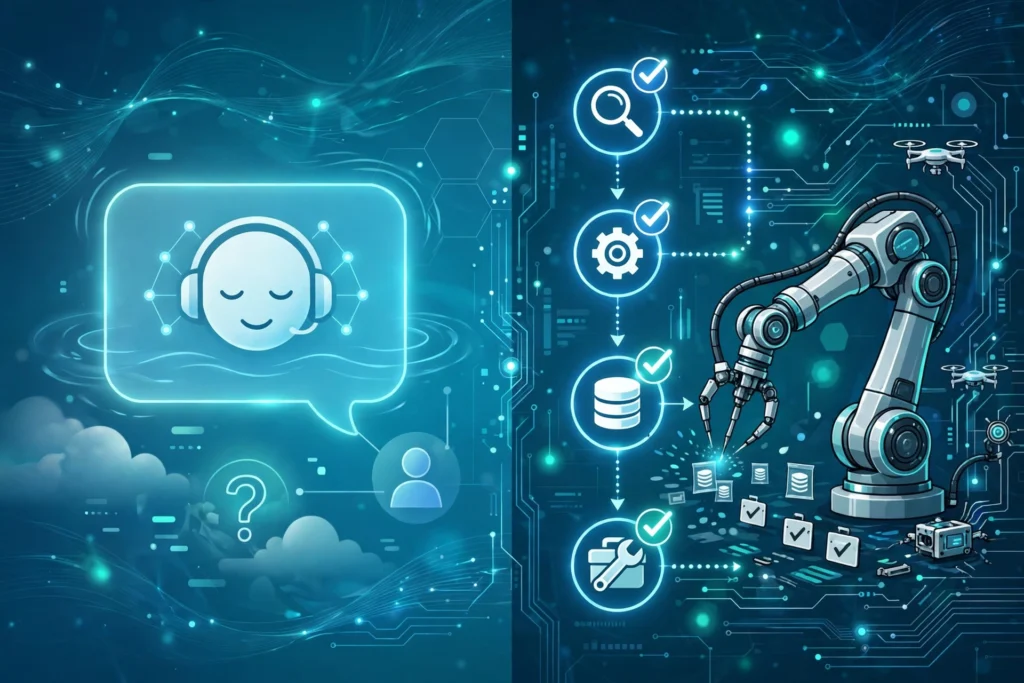
If you have been following AI news in 2026, you have seen the word agent everywhere. Every chatbot suddenly calls itself an AI agent — but most are AI assistants wearing a fancier label. Understanding the real difference between AI agents vs AI assistants matters, because the two solve very different problems and carry very different risks.
The simplest summary from the developers building these systems: an assistant answers questions; an agent completes jobs. An assistant waits for your prompt, does one thing, and stops. An agent takes a goal, plans the steps itself, uses tools on its own, and keeps working until the job is done.

What Is an AI Assistant?
An AI assistant is a reactive, prompt-driven helper. You ask, it answers. You stop asking, it stops working. Every action needs your explicit instruction, and the output — a draft, a summary, a code snippet — comes back to you before anything happens in the real world. ChatGPT chat, Claude.ai, Gemini, Copilot’s inline suggestions, Siri, and Alexa all work this way. Many free AI tools students love in 2026 are assistants — helpful, but passive.
What Is an AI Agent?
An AI agent works on delegated autonomy. You set the goal and the constraints; it decides how to reach the goal. It loops: perceive, plan, act through tools, observe results, adapt when things fail. The three enablers are tool use (APIs, browsers, databases), persistent memory, and planning. Examples: Devin, OpenAI’s “dots” agent, Salesforce Agentforce, and Klarna’s support agents that resolve tickets end-to-end alone.
AI Agents vs AI Assistants: The Key Differences
- Autonomy: an assistant waits for every instruction; an agent decides its own next steps.
- Tool use: optional in assistants; central to agents — APIs, browsers, your software.
- Planning: an assistant works one reply at a time; an agent orders and executes subtasks.
- Memory: session-bound in assistants; persistent across steps and sessions in agents.
- Failure handling: an assistant stops and waits; an agent retries, reroutes, or escalates.
- The write-back test: after it finishes, did it write back — update the CRM, close the ticket, send the invite? Yes = agent. No = assistant.
The 3-Question Test: Is It Really an Agent?
Vendors slap “agent” on everything in 2026. Test any product with three questions:
- Can I give it a goal instead of step-by-step instructions, and will it figure out the steps? Yes = agent.
- Does it use other tools or software on its own, mid-task? Yes = agent.
- If something goes wrong halfway through, does it adapt — or stop and report the error? Adapts = agent.
Three yeses: you have an agent. Anything else: an assistant with good marketing.
The Grey Area: When the Same Product Is Both
The line is often configuration-dependent, not vendor-fixed. Claude becomes an agent when computer use is on — and an assistant when it is off. Copilot is an assistant in inline-suggest mode but an agent in Agent Mode. The right question is never “is this company an agent company?” — it is “in this mode, who drives the loop?”
When to Use Which
- Use an AI assistant for discrete tasks where you want to stay in the review loop: drafting, summarising, explaining, brainstorming, code snippets.
- Use an AI agent for multi-step workflows that touch external tools and can run without hand-holding: ticket routing, CI triage, meeting scheduling, inventory monitoring.
Rule of thumb: if the cost of a wrong autonomous action outweighs the cost of a manual handoff, stay with the assistant. For where agents are heading, see the newest AI tools launched this month.
The Hidden Risk: An Agent’s Blast Radius
An assistant’s blast radius is bounded by you — the human reviewer. An agent’s blast radius is bounded by what its tool layer can touch. Give an agent write access to your CRM, email, and payments, and a bad plan becomes a real incident, not just a bad draft.
That is why agents need approval gates and an audit trail per action. The most common enterprise mistake of 2026 is buying an agent but governing it like an assistant. If you are experimenting, start with a no-code AI agent builder and keep a human approval step before anything outward-facing.
FAQs
Are AI assistants and AI agents the same thing?
No. With an assistant, you drive: it responds to your prompt and waits for the next one. With an agent, the system drives: it pursues a goal across multiple steps, using tools and tracking state, and returns to you only for goal-setting and review.
Can an AI assistant become an agent?
Yes — by changing configuration, not vendor. Turning on tool access, browser use, or an “agent mode” can move the same product across the line. That is why the 3-question test looks at behaviour, not brand names.
Which is better: an AI agent or an AI assistant?
Neither is universally better. Assistants win for quick, creative, human-judged work. Agents win for repetitive multi-step workflows. Most people get more value from a supervised assistant than from an agent they cannot fully trust yet.
Do AI agents cost more to run than assistants?
Usually, yes. One chat reply is one model call; an agent looping through 20 steps with tool calls and retries burns far more tokens. Start agents on small, cheap tasks before scaling.
Conclusion
The difference between AI agents vs AI assistants is not how smart the model is — it is autonomy and action. An assistant talks; an agent does. Ignore the marketing, run the test: who drives the loop, does it use tools on its own, and did it write back when finished? Answer that and you will know exactly which tool your task needs. For more practical AI guides, explore the AI section on KamiWeb.