
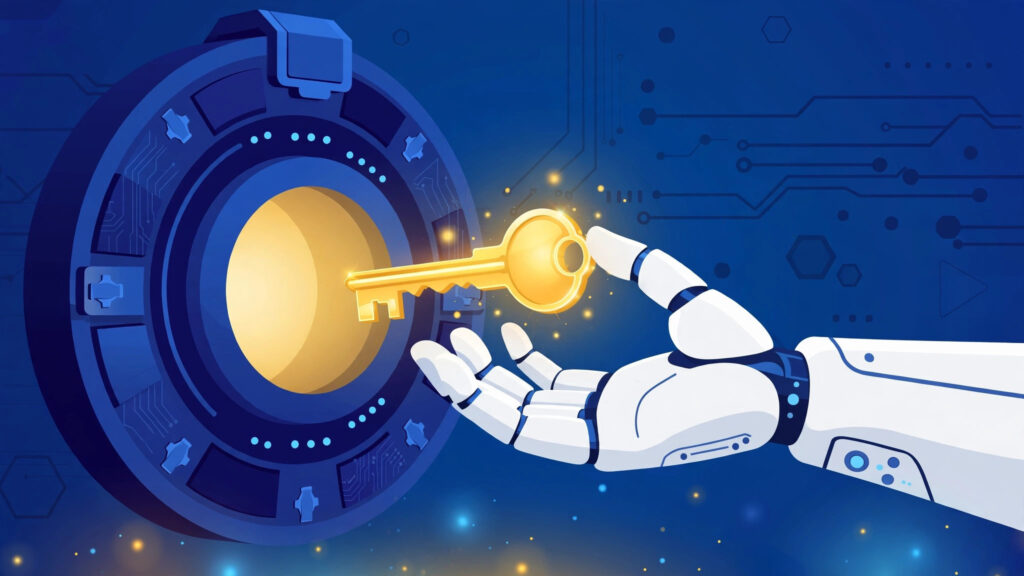
AI agents are moving from answering questions to actually doing things: opening tools, pulling reports and completing multi-step tasks on your behalf. But most of the software they need to touch still asks the same old question — what is the username and password? Handing real credentials to an AI model creates an obvious risk. 1Password, the company behind one of the most widely used password managers, announced 1Password for Agents on October 22: a way for AI agents to sign in to services without ever seeing the password itself.
How 1Password for Agents Works
The idea builds on what password managers already do for people. Instead of a human typing a password, the credential stays inside the vault, and 1Password handles the sign-in on the agent’s behalf. The agent gets the access it needs to complete a task, while the underlying secret — the actual password — is never handed over to the model, typed into a chat or written into a prompt.
That separation matters because of how agents work. Everything an agent “sees” can end up in context windows, logs or tool calls. A credential that never enters that stream cannot leak through it. And as more of our work moves through small connected services — our roundup of free online tools shows just how many there are — every one of those logins becomes something worth protecting properly.
Why Keeping Passwords Away From Agents Matters
Security professionals have warned for years that the weakest point of any automated system is the credential it carries. Agents add new twists: they can be steered by prompt injection, tricked by malicious webpages or documents, and they often keep detailed records of their actions. If an agent holds a real password, every one of those risks attaches itself to that password.
Keeping secrets in a dedicated vault follows the same principle as good personal privacy hygiene. Just as tools like our AI Face Blur keep sensitive details out of photos before you share them, a credential vault keeps secrets out of an agent’s working memory before it acts. The agent can still do the job — it just never holds the keys.
Part of a Bigger Push to Make Agents Trustworthy
1Password for Agents does not arrive in isolation. Across the industry, the conversation is shifting from what agents can do to how their work can be verified and controlled. GitHub Next is exploring formal proof for agent-written code, while Nuix is building agentic AI with an audit trail so every action can be reviewed afterwards. Identity, verification and accountability are becoming the three legs of the enterprise agent stack.
That framing helps explain the timing. Large companies are piloting agents on real workflows, and their security teams are asking hard questions about access. A sign-in layer designed for agents, with the password kept out of the model’s reach, answers one of the first questions on that list.
What It Means for Teams
For teams experimenting with agents, the practical takeaway is simple: treat agent access like employee access. Give it only what it needs, keep real credentials in a managed vault, and prefer tools that authenticate on the agent’s behalf instead of exposing secrets. As agents take on more routine work, the organisations that get identity right early will move faster — and sleep better.
Frequently Asked Questions
What is 1Password for Agents?
It is a 1Password offering, announced on October 22, that lets AI agents sign in to services through the vault without the agent ever seeing the actual password.
Why not just give an AI agent the password?
Anything an agent sees can surface in prompts, logs or tool calls, and agents can be manipulated by malicious content. Keeping the password inside a vault removes that whole class of risk.
Who is it for?
Teams and developers deploying AI agents that need to access real services — the same audience now bringing agents into everyday business workflows.